How Loan EMIs Work (and How to Calculate Them)
What an EMI is, the formula behind it, how principal, interest rate, and tenure change your monthly payment, and how to read an amortization schedule — explained simply.

Not financial advice
This guide explains the mechanics of loan EMIs for educational purposes. It isn’t financial advice. For decisions about borrowing, check your lender’s exact figures and consider speaking to a qualified professional.
Whether it’s a home, car, or personal loan, the number that matters month to month is the EMI — your Equated Monthly Installment. Understanding how it’s calculated demystifies loan offers and helps you see the real cost of borrowing, not just the monthly figure. Here’s how it works.
What an EMI actually is
An EMI is a fixed monthly payment that clears your loan over an agreed period. Each installment covers two things:
- Interest on the outstanding balance, and
- A chunk of the principal (the amount you borrowed).
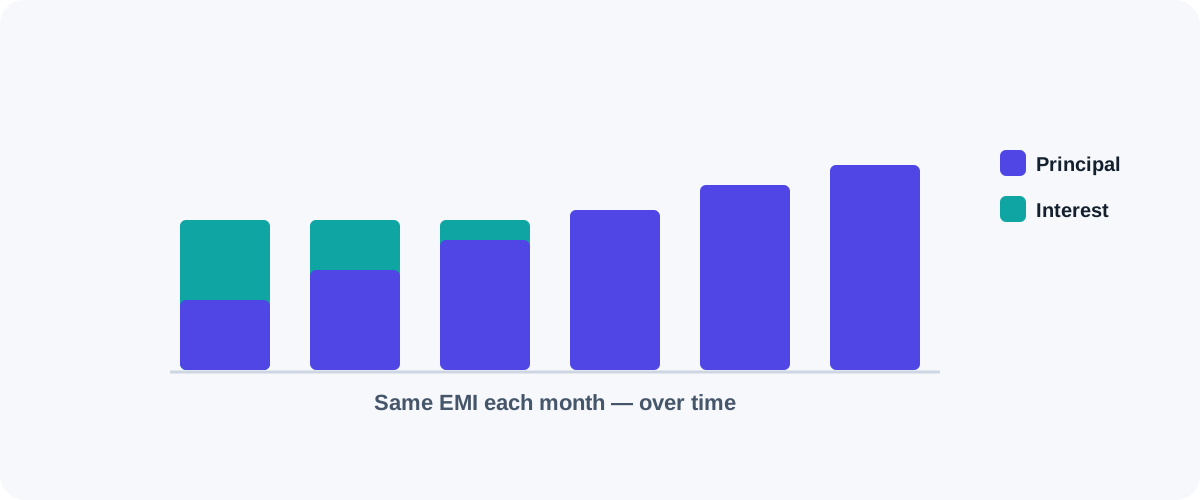
The payment stays the same each month, but the split shifts: early on you’re mostly paying interest; later you’re mostly paying down principal. More on why below.
The three things that decide your EMI
- Principal (P) — how much you borrow. More principal → higher EMI.
- Interest rate (r) — the annual rate, converted to monthly. Higher rate → higher EMI.
- Tenure (n) — the number of months. Longer tenure → lower EMI but more total interest.
The formula
EMI = P × r × (1 + r)^n ÷ ((1 + r)^n − 1)

P = principal
r = monthly interest rate = annual rate ÷ 12 ÷ 100
n = number of monthly installments
It looks heavy, but it’s just three inputs. Let’s run a real example.
A worked example
Say you borrow 500,000 at 10% per year for 5 years:
P = 500,000
r = 10 ÷ 12 ÷ 100 = 0.008333
n = 5 × 12 = 60 months

EMI ≈ 10,623 per month
Total paid ≈ 10,623 × 60 = 637,380
Total interest ≈ 137,380
So the loan costs about 137,380 in interest on top of the 500,000 borrowed. Seeing the total — not just the 10,623 monthly — is the point of doing the math.
How tenure changes everything
Stretching the same loan over more years lowers the monthly payment but raises the total cost:
| Tenure | Approx EMI | Approx total interest |
|---|---|---|
| 3 years | ~16,134 | ~80,800 |
| 5 years | ~10,623 | ~137,380 |
| 7 years | ~8,301 | ~197,300 |
(500,000 at 10%.) The 7-year option is easiest monthly but costs roughly 2.4× more interest than the 3-year. That trade-off — affordability now versus cost overall — is the key decision in any loan.
Why early payments are mostly interest
Interest is charged on the outstanding balance, which is largest at the beginning. So in month one, most of your EMI covers interest and only a little reduces the principal. As the balance falls, the interest portion shrinks and more of each fixed EMI goes to principal. This is called amortization, and a schedule lays it out month by month:
| Month | EMI | Interest | Principal | Balance |
|---|---|---|---|---|
| 1 | 10,623 | 4,167 | 6,456 | 493,544 |
| 2 | 10,623 | 4,113 | 6,510 | 487,034 |
| … | … | … | … | … |
| 60 | 10,623 | 88 | 10,535 | 0 |
Why prepaying early helps most
Because early balances are highest, paying extra toward the principal early in the loan removes future interest most effectively. The same prepayment near the end saves far less. If your loan allows penalty-free prepayment, early is where it pays off.
Using a calculator
You rarely compute the formula by hand — an EMI calculator does it instantly and, crucially, shows the total interest and the amortization schedule. Use it to compare scenarios: nudge the tenure and rate and watch how the monthly payment and the total cost move. That comparison, more than the single EMI figure, is what helps you borrow sensibly.
Frequently asked questions
What does EMI stand for?
Equated Monthly Installment — the fixed amount you pay every month until a loan is fully repaid. Each payment is the same size, but its split between interest and principal changes over time: early payments are mostly interest, later ones mostly principal.
What's the formula for EMI?
EMI = P × r × (1 + r)^n ÷ ((1 + r)^n − 1), where P is the principal, r is the monthly interest rate (annual rate ÷ 12 ÷ 100), and n is the number of months. It looks intimidating but it's just plugging in three numbers.
Does a longer loan tenure reduce my EMI?
Yes, a longer tenure lowers the monthly payment because you're spreading the principal over more months. But it increases the total interest you pay over the life of the loan, sometimes substantially. Lower monthly cost, higher total cost.
Why is so much of my early EMI going to interest?
Because interest is charged on the outstanding balance, which is highest at the start. As you pay down the principal, the interest portion of each EMI shrinks and the principal portion grows. This is normal and is shown clearly in an amortization schedule.